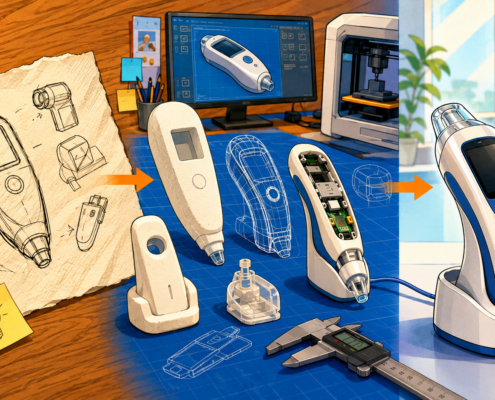
From Napkin Sketch to Market-Ready: A Sketch-to-Production Design Story
What do superheroes and great products have in common? They have origin stories.
Sometimes it starts as a clinical frustration.
Sometimes it begins with a founder’s “what if?”
Sometimes it’s a rough sketch on a…

What Medical Device Designers Can Learn from a Heinz Ketchup Bottle
At MD&M Minneapolis 2019, Brian Mullins, director of design and development at Kablooe Design, used the original Heinz Ketchup bottle as an example of why it's important to invest in the design of a product.
The Great Design Bake-Off: How to Measure Product Success
Every great product starts with a recipe.
Not the kind written on an index card and passed down from your grandma, although we love that kind too. We’re talking about the recipe that turns a promising idea into a product people actually…

5 Hidden Potholes of Medical Product Development
Coming up with a novel idea for a medical device is easy. Creating a medical device company is hard.
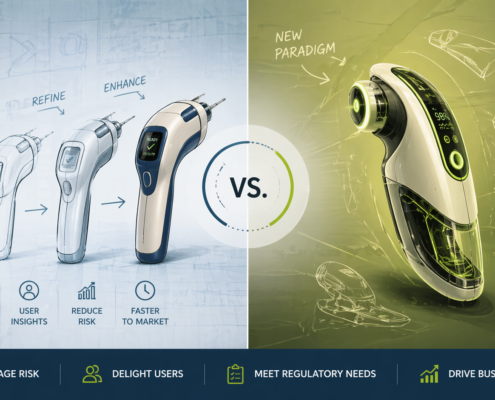
Is Your MedTech Design Revolutionary or Evolutionary?
Your design may not be a breakthrough, but could it help you break free from some regulatory burden?

The Goldilocks Principle of Usability: Not Too Complex, Not Too Simple
Once upon a time, a little girl named Goldilocks wandered into the woods and entered a house that didn’t belong to her. Inside, she found three bowls of porridge.
One was too hot.
One was too cold.
And one—just one—was just…

Fail Early, Fail Often, Fail Smart: The Power of Iterative Design
Failure has a branding problem.
In product development, especially in medical technology, failure can sound like the thing everyone is trying to avoid. Failed tests. Failed launches. Failed assumptions. Failed investments.
But when…
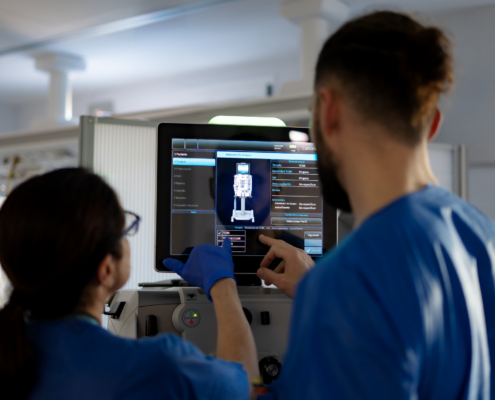
How to Design a Better Medical Device User Interface
Those of us who are in the design industry typically spend a lot of our time thinking about the person who is going to use our fabulous invention, and what the situation is like when they will be using it...

Class is in Session: How Kablooe Excels in Class I, II, & III Medical Devices
Welcome to today’s lesson on Medical Device Classification 101. Don’t worry—there won’t be a pop quiz at the end. But by the time the bell rings, you’ll walk away with a clear understanding of how Class I, Class II, and Class III…

Aging-in-Place Technology: How Innovation and Empathy Are Redefining Home-Based Healthcare
“We’re not just designing devices—we’re designing dignity.”
That sentiment, shared by Kablooe CEO Fred Sklenar during his MD&M Midwest presentation, perfectly captures the mission behind today’s most impactful healthcare…