The Great Design Bake-Off: How to Measure Product Success
Every great product starts with a recipe.
Not the kind written on an index card and passed down from your grandma, although we love that kind too. We’re talking about the recipe that turns a promising idea into a product people actually want, trust, use, and recommend.
And just like baking, product development can go sideways fast if you miss the details.
Too much assumption? The whole thing collapses.
Not enough user research? An undercooked product at launch.
Skip testing? Hope you enjoy surprises.
Rush the process? Burnt edges, soggy middle, and a team wondering what happened.
Great design isn’t magic. It’s a mix of creativity, discipline, timing, testing, and just enough humility to admit when the first batch isn’t quite right.
So, welcome to the Great Design Bake-Off. Today’s challenge: create a recipe for product success.
Key Takeaways
- Product success metrics are the agreed-upon measures a team uses to determine whether a product is doing its job for users, the business, and manufacturing.
- There is no universal scorecard. A medical device, a consumer product, and an industrial tool each need a different mix of measures.
- Define success before development starts. Metrics chosen after launch tend to justify decisions rather than guide them.
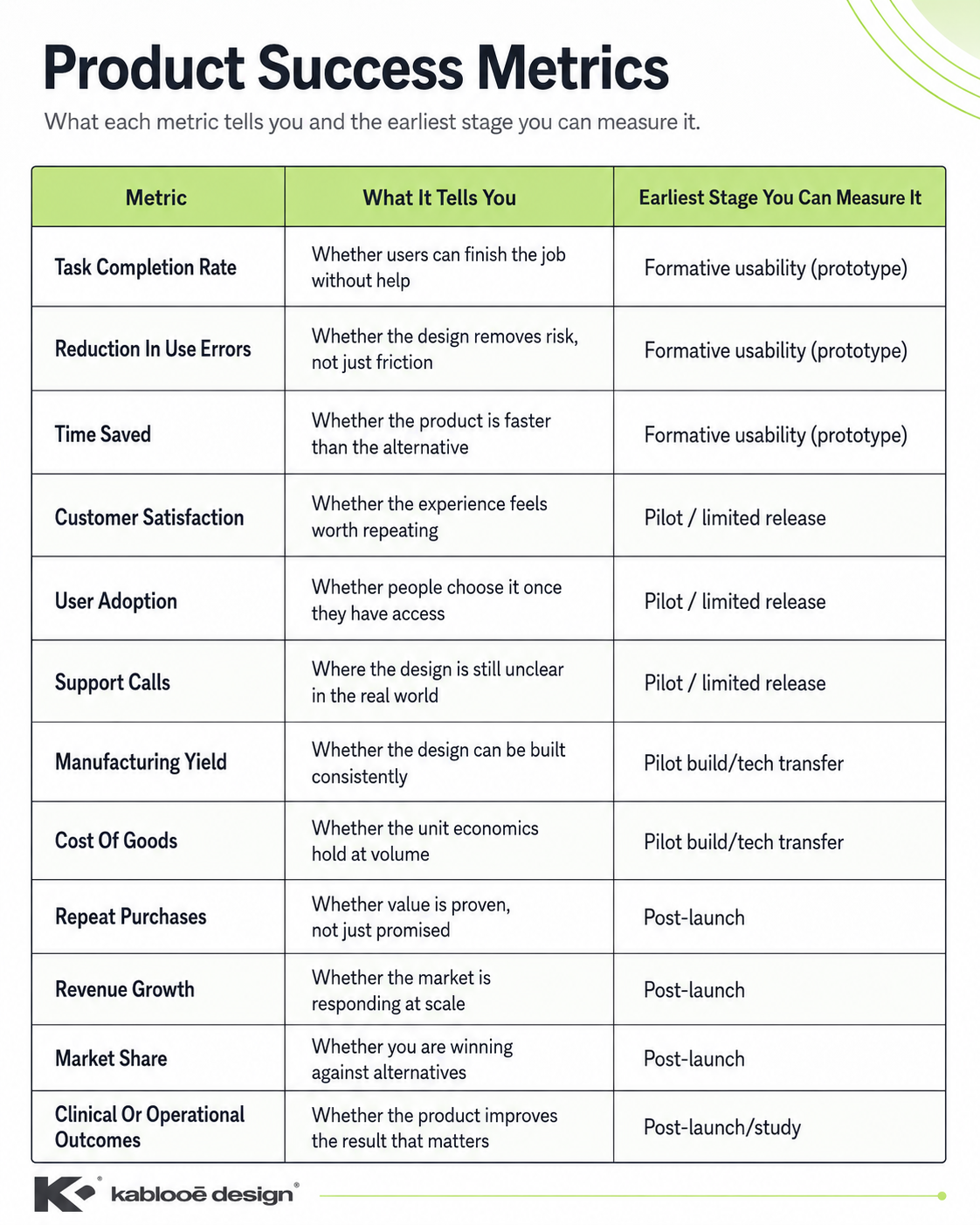
- The earliest signals are qualitative. Formative usability sessions and concept feedback tell you more at week six than revenue data will at month twenty-four.
- Success is measured across the whole process. Research, ideation, prototyping, testing, engineering, and tech transfer all carry their own indicators.
What Are Product Success Metrics?
Product success metrics are the specific, agreed-upon measures a team uses to judge whether a product is achieving what it was built to achieve. They typically span three areas: whether users adopt and can actually use the product, whether it performs technically and can be manufactured reliably, and whether it delivers a return the business can sustain.
The strongest metric sets are defined early, tied to a specific user and use case, and measurable before launch, not just after.
Ingredient One: A Clear Problem Worth Solving
Before any good baker preheats the oven, they know what they’re trying to make. Cake? Bread? Soufflé? A very ambitious croquembouche that may or may not survive the walk to the table?
Product design works the same way.
A team needs to know what problem they’re solving, who they’re solving it for, and why the current alternatives aren’t good enough. Without that clarity, even a beautiful product can end up solving the wrong problem.
This is where early research matters. Teams need to understand real users, use environments, workflows, pain points, purchasing influences, technical constraints, and market expectations. That doesn’t mean slowing everything down. It means gathering enough insight to keep the team from confidently marching toward the wrong oven.
Need some direction? Our 9-step guide to product development research is a great place to start.
Ingredient Two: The Right Mix of User Insight and Business Strategy
A product can delight users and still struggle in the market if the business case isn’t clear. It can also satisfy a business objective and still fail if users find it confusing, frustrating, or unnecessary.
The winning recipe needs both.
User insight tells you what people need, how they behave, where they struggle, and what would make their lives easier. Business strategy helps define where the product fits, how it creates value, what stakeholders care about, and what success looks like.
This is where teams should start thinking seriously about product success metrics.
Not every product needs the same scorecard. A medical device, consumer product, connected platform, and industrial tool will each have different measures of success.
The point is to define success before the product comes out of the oven.
If your team is asking how to measure product success, the answer starts with understanding what value the product is supposed to create and for whom. Then, you can choose metrics that reflect whether the product is actually doing its job.
Ingredient Three: Ideation (Without the Messy Kitchen Panic)
Ideation is the fun part, but it can also get chaotic at times.
This is where napkin sketches, whiteboard scribbles, half-formed ideas, weird analogies, bold suggestions, and “what if we tried…” conversations start flying around. That’s good. The early mess is part of the process.
But productive ideation needs structure.
Teams should explore multiple directions, compare tradeoffs, invite different perspectives, and resist the urge to fall in love with the first decent concept. The goal isn’t to make every idea precious. The goal is to uncover better possibilities.
In baking terms, this is your test kitchen. Try the unexpected flavor combination. Make the tiny sample batch. Ask someone to taste it before you commit to 400 cupcakes.
Our article on the 9 key steps to supercharge your product development ideation dives deeper into how teams can make ideation more productive.
Ingredient Four: Early Prototyping and Product Evaluation
At some point, the recipe has to leave the page.
That’s where prototyping and evaluation come in. Sketches, models, mockups, simulations, clickable interfaces, proof-of-concept builds, and functional prototypes all help teams make ideas tangible.
The key is choosing the right level of fidelity for the question you’re trying to answer.
A sketch may be enough to compare product layouts. A foam model may help evaluate ergonomics. A clickable prototype may reveal workflow confusion. A functional prototype may help test technical feasibility. A more refined model may support stakeholder buy-in or early usability feedback.
Want to know how to test how successful a product will be? You test it by putting the idea in front of the right people, in the right way, at the right stage. You don’t wait until everything is polished. You look for evidence early.
And yes, emotional attachment is real. Nobody wants to hear their beautiful concept is dry, dense, or missing the point. But that feedback is a gift when there’s still time to fix the recipe.
Our guide to breaking down the 5 steps of product evaluation offers a practical framework for evaluating ideas before too much time, money, and emotional attachment are baked in.
Ingredient Five: Testing, Iteration, and a Willingness to Adjust
A great baker tastes along the way. Product teams should too.
Testing and iteration help teams refine the product based on evidence instead of assumption. Sometimes the changes are small. A clearer label. A better grip. A simplified workflow. A more intuitive interaction. Other times, testing reveals that the team needs to rethink a major piece of the concept.
That’s not failure. That’s learning.
If you want to see what that looks like, our case studies walk through how these ingredients came together in real products, including the batches that needed a second pass.
The product development process should create room for adjustment. Teams that treat every design decision as final too early often end up paying for it later. The better approach is to test, learn, refine, and repeat until the product is stronger.
This matters even more in complex or regulated product categories, where usability, safety, manufacturability, documentation, and reliability all affect product success.
Measuring Product Success in Regulated Categories
In regulated categories, success measurement is not optional, and it is not informal. Under FDA design controls, a team defines user needs and design inputs up front, then has to demonstrate through verification and validation that the finished device meets them. In practice, that turns “how will we know this worked?” into a documented requirement rather than a conversation.
That gives regulated teams a built-in measurement rhythm. Formative usability studies run during development to find and fix use-related risk while changes are still cheap. Summative (validation) testing then demonstrates that representative users can perform critical tasks safely and effectively. Both produce hard numbers (first-attempt success rate, use-error frequency, task time) well before a single unit ships.
The teams that treat those studies as evidence rather than paperwork tend to launch with fewer surprises, because the metrics that matter most to regulators overlap heavily with the metrics that matter most to users.
The goal isn’t simply to launch. The goal is to launch something that works in the real world.
Our article on 8 steps to success during new product design development explores how thoughtful structure can help teams move from early concept to stronger product outcomes.
Ingredient Six: Engineering That Makes the Recipe Scalable
A gorgeous prototype that can’t be manufactured is like a showstopper dessert that melts before judging. Looks great for a minute. Big problems later.
Engineering brings discipline to the recipe. It helps translate the product vision into something reliable, manufacturable, cost-aware, and ready for the realities of production.
This is where teams need to think about materials, mechanisms, electronics, software, assemblies, tolerances, regulatory requirements, suppliers, manufacturing processes, and long-term support.
Strong engineering doesn’t kill creativity. It protects it. It keeps the best parts of the idea intact while making sure the final product can survive outside the test kitchen.
Our guide on the essential steps of product design engineering covers the role engineering plays in turning strong concepts into products that can actually be built.
Ingredient Seven: Tech Transfer and Production Support
Even a great recipe can fall apart when it moves from a commercial kitchen to an event venue.
That transition matters.
Tech transfer is where the product moves from development into manufacturing. It requires communication, documentation, supplier alignment, quality planning, and a clear understanding of how the product will be built consistently.
A smooth handoff can reduce confusion, protect design intent, and help teams avoid production delays.
And once production begins, the work isn’t necessarily over. Teams may still need manufacturing support, troubleshooting, supplier coordination, design refinements, or process improvements.
That’s part of how you protect product success over time.
To learn more, check out our articles on the tech transfer process and manufacturing production support.
So, How Do You Measure Product Success?
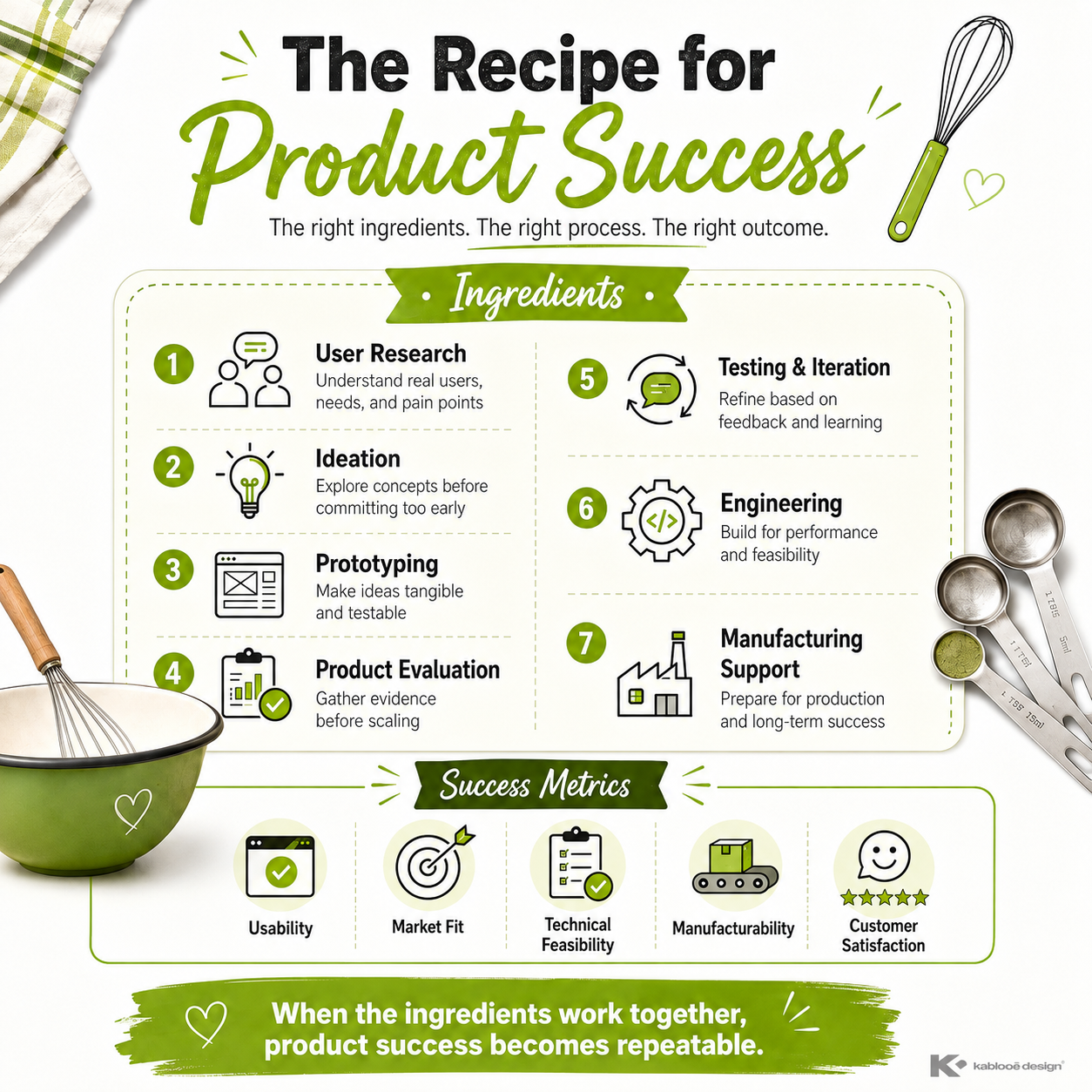
There’s no single universal answer, because not every product is trying to accomplish the same thing. But strong product success metrics usually connect back to three big questions.
1. Do Users Want It and Use It?
This is the question that fails quietly. Adoption, task completion, and use-error rates answer it, and all three can be measured on a prototype long before launch. If users can’t complete a critical task without coaching, no amount of downstream marketing fixes it.
2. Does It Solve the Problem Better Than the Alternatives?
Not “is it good” but “is it better than what people are doing today.” The comparison has to be against the real alternative, including the workaround, the incumbent device, and doing nothing at all. Time saved and outcome improvement are the usual measures.
3. Can the Business Deliver It Sustainably?
Manufacturing yield, cost of goods, service burden, and supply stability. A product that works beautifully and can’t be built repeatably at target cost is a prototype with a launch date.
For example, a home-use drug delivery device team might set first-attempt task success at 95% during formative usability, target a measurable reduction in use errors against the incumbent, and hold cost of goods to a defined ceiling at pilot volume. Three numbers, all measurable before launch, each tied to one of the three questions above. That means teams may need to measure desirability, usability, safety, technical performance, adoption, financial impact, manufacturability, quality, and long-term satisfaction.
A successful product doesn’t just look good in a pitch deck. It performs in the hands of real users, fits into the market, supports the business, and can be manufactured with confidence.
The Winning Recipe Takes More Than One Ingredient
Product success isn’t the result of one ingredient.
- It’s not just a great idea.
- It’s not just beautiful design.
- It’s not just technical performance.
- It’s not just a strong launch plan.
It’s the combination.
The best products come from teams that know how to balance creativity and discipline. They research before assuming. They prototype before committing. They test before scaling. They measure what matters. And they keep improving the recipe until the final product is ready for the people who need it.
At Kablooe, that’s the work we love.
We help teams turn raw ideas into thoughtful, user-centered, manufacturable products that are built for the real world. Sometimes that means stirring up new concepts. Sometimes it means fixing a recipe that’s gone a little sideways. And sometimes it means helping a team figure out whether the thing they’re baking is actually what the market ordered.
Kablooe is a product development partner, not a competitor to the companies we serve. We don’t sell rival products. We design, engineer, and support the products our clients bring to market under their own brands. Our design-driven development approach exists so their product success metrics improve, because that’s the only scorecard we get graded on.
And we can do the same for you. Let’s talk.
Want a more reliable recipe for product success?
Kablooe’s D3® Process brings structure, creativity, user insight, and engineering discipline together to help teams move from early idea to meaningful impact.
Download the D3 Process eBook to learn how design-driven development can help your team create products that are thoughtfully designed, carefully tested, and ready for what comes next.