Medical Device & Product Design Services

35+ Years of Medical Product Design Experience

Kablooe Design is a Minneapolis-based medical device design and development firm. When you are developing a new MedTech device, you shouldn’t have to do it alone. Whether you’re creating a diagnostic biosensor or a minimally invasive surgical implant tool, you need a partner who specializes in medical device design services and development to help bring your vision to life. At Kablooe, we specialize in both, with 35+ years of experience working with MedTech startups, Fortune 500 companies, and everything in between.

Medical Device Design Services: by Device Type

Coming up with a novel idea for a medical device isn’t easy, but it is the easiest part of getting that idea to market. Unless you have someone in mind that wants to buy your idea right out of your head, you’ve got a long road of medical product development work ahead of you. Mind if our medical device design engineers take the wheel on that one?

Wearable Device Design

Diagnostic Equipment Design

Surgical Device Design

In-Home Health Device Design

Comprehensive Medical Device Design Solutions

Kablooe’s solutions keep you at the forefront of healthcare innovation. We leverage our decades of industry experience with medical device design in order to take many of these tedious and time-consuming product development tasks off of your plate.

Formative & Summative Studies

From developing a study script and moderating sessions to analyzing data and generating a report, we can ensure your involvement in the initial research process is as simple, streamlined, and straightforward as possible.

Usability Documentation

When a product is intuitive and easy to use, it reduces frustration and stress – helping patients feel more at ease and supported throughout their experience. Our UI/UX design experts keep this top of mind, thoughtfully balancing form and function in the development of our medtech devices.

Risk Management

Since the FDA will only approve devices that are safe and effective, mitigating risk is one of the cornerstone activities in medical product design. That’s why we place such a big emphasis on anticipating and avoiding the many risk-related challenges faced in this demanding market.

Regulatory Compliance

Leading healthcare OEMs trust Kablooe because we know what it takes to design and develop successful MedTech devices. Our D3(tm) process is in compliance with ISO 13485, and we have experience developing products to comply with standards: HE75, ISO 9001, ISO 14001, IEC 13485, IEC 60601, IEC62366, and FDA Class II and III.

Cloud Data Collection

Our team of cloud and IoT experts will help you with all your backend technology needs, from wearable data collection to AI sorting—all while providing the advanced security you need to protect sensitive EMR.

Verification & Validation

Our rigorous medical product design process ensures your device fulfills its intended purpose by catching and correcting any potential problems before they arise. This serves to set up formal V&V by a CM, shorten the time to market, and deliver the highest quality patient experience.

Medical Device Design Case Studies

Thirty-five years of medical device design work is easier to trust when you can see it. Below are representative programs; each links to the full case study.

  • EarliTec Diagnostics — EarliPoint™ Evaluation: Fewer than 20% of children with autism are assessed before age three, and EarliTec needed a diagnostic device that could seat a wide range of child heights without tipping. Kablooe ran the program from requirements development and ideation through bench testing, vendor management, and low-volume production hand-off, solving the stability problem with a knob-interface stand and case that adjusts height quickly and locks securely. EarliTec has since raised over $21M to bring the EarliPoint™ Evaluation to market. Read the EarliTec autism diagnostic case study.
  • Preceptis Medical — The Hummingbird®: Placing pediatric ear tubes normally requires general anesthesia, and Preceptis needed a device a physician could operate while keeping a child still with the other hand. Kablooe developed the mechanical functionality and user touchpoints, consolidating steering, deployment, and suction into one-handed control in an ergonomic body the size of a ballpoint pen, then carried the design through clinical trials toward commercialization. The Hummingbird® succeeded in clinical trials and won the MN Cup Award. Read the Preceptis Hummingbird case study.
  • NxThera — Rezūm Prostate Ablation System: NxThera had a novel water-vapor ablation therapy for BPH but needed it engineered into a usable clinical system. Kablooe applied the D3® process across the handpiece and the capital generator, designing a trigger-actuated needle deployed perpendicular to the catheter and integrating both flush capability and the RF steam-generation coil into the handle, so the clinician completes the full ablation procedure without withdrawing the device from the patient. The result was a shorter, simpler procedure and a commercialized system. Read the Rezūm ablation system case study.

See all Kablooe medical device case studies.

Are You Ready To Make Products People Love?

Devices should delight users in ways they’d never expect. We do that.

We Handle the ‘Not So Fun’ Stuff Too

Most devices these days are highly regulated, particularly those in the medical field. So let our human factors consulting team take many of these tedious and time-consuming compliance tasks off your plate. This ensures your involvement in the approval process is as simple, streamlined, and straightforward as possible.

Our HFE core competencies include:

  • Submitting HFE files to the FDA
  • Supporting risk management
  • Conducting formative and summative studies
  • Ensuring HE75 and IEC62366 compliance
  • Following HFE design protocols
  • ISO 13485 Quality Management
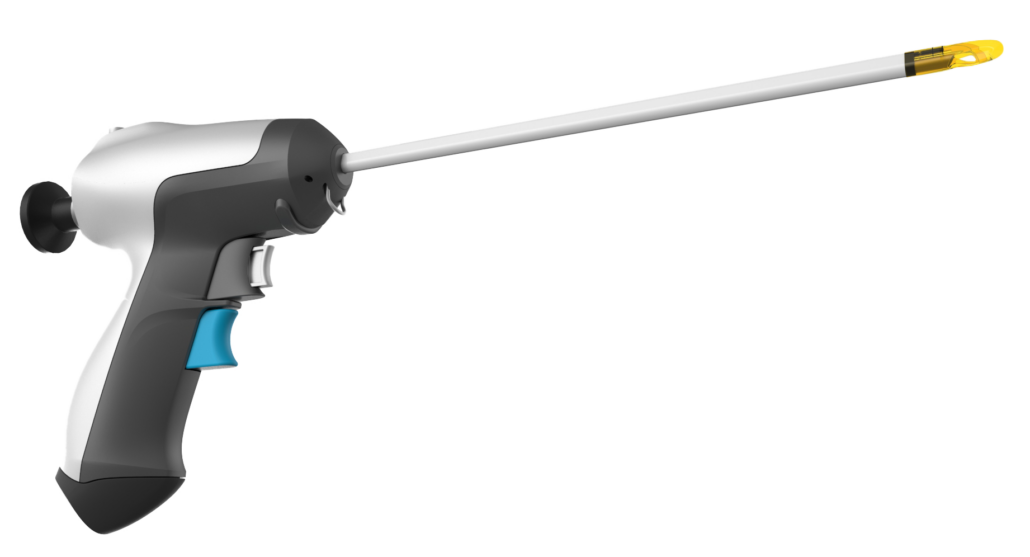
A medical device with a pistol-grip handle, trigger, and a long, thin tube with a yellow tip, likely used for minimally invasive surgical procedures.

Let’s Work Together

Medical Product Design Form
Name
Name
First Name
Last Name
Kablooe Design needs the contact information you provide to us to contact you about our products and services. You may unsubscribe from these communications at anytime. For information on how to unsubscribe, as well as our privacy practices and commitment to protecting your privacy, check out our Privacy Policy.

Medical Device Design FAQs

What regulatory standards and certifications guide Kablooe’s medical device design process?

Kablooe’s Design Driven Development (D3®) process is certified to ISO 13485:2016, the quality management standard for medical devices. We design to FDA Class II and III requirements and apply ISO 14971 for risk management, IEC 62366-1 and FDA HE75 for usability and human factors, IEC 60601 for electrical safety, plus ISO 9001 and ISO 14001.

  • ISO 13485:2016: the quality management system standard written specifically for medical devices. Certification is independently audited, unlike self-declared compliance, and most OEMs and notified bodies require it of a design partner before work begins.
  • FDA Class II and III: the risk classifications that determine your regulatory pathway. We design to 510(k) and PMA expectations so your design history file (DHF) is built as the program progresses rather than reconstructed before submission.
  • ISO 14971: the risk management standard for medical devices. It requires hazard analysis and risk controls to be traceable through every design decision, which is one of the most common gaps reviewers flag.
  • IEC 62366-1: the usability engineering standard. It defines how you identify use-related hazards and demonstrate your device is safe in the hands of real users, not just on the bench.
  • FDA HE75: a human factors design guidance document. Broader and more prescriptive than IEC 62366-1, it covers interface design, labeling, alarms, and environment-of-use considerations.
  • IEC 60601: the electrical safety and essential performance standard for electro-medical equipment. Designing to it from the start avoids costly redesigns after a test-lab failure late in the program.
  • ISO 9001: the general quality management standard. Holding it alongside ISO 13485 is relatively uncommon for design firms and signals process discipline across all of our work, not only regulated projects.
  • ISO 14001: the environmental management standard. It is increasingly requested in OEM supplier audits and is rare among product design and development firms.

What is human factors engineering, and why is it required for medical devices?

Human factors engineering (HFE) is the practice of designing a device around the abilities and limitations of the people who will actually use it: clinicians, caregivers, and patients. The FDA requires it because a large share of device problems trace back to use error rather than component failure. IEC 62366-1 and FDA HE75 define how you identify use-related hazards and prove the device is safe in real hands.

What’s the difference between formative and summative usability studies?

Formative studies happen during design. They are exploratory, use small participant groups, and exist to find and fix usability problems while changes are still inexpensive. Summative (validation) studies happen at the end, use representative users under simulated real-use conditions, and produce the evidence the FDA reviews. Formative work shapes the device; summative work proves it.

How long does the medical device design process typically take, from concept to production?

Most programs run roughly 12 to 24 months from concept to production, but the range is wide. Device class, software content, electrical complexity, and whether clinical data is required all move the timeline. A Class II mechanical device with a clear predicate can move considerably faster than a Class III device on a PMA pathway.

What types of medical devices does Kablooe design?

Kablooe designs wearable devices, diagnostic equipment, surgical and minimally invasive devices, in-home health devices, and connected devices with cloud or IoT components. Our work spans Class I through Class III, from single-use disposables to capital equipment.

Does Kablooe support FDA submissions and risk management for Class II/III devices?

Yes. We prepare human factors engineering files for FDA submission, support risk management under ISO 14971, and build design history file documentation as the program progresses rather than assembling it afterward. We act as your design and development partner, producing the engineering and usability evidence a submission depends on.

Where is Kablooe located, and do you work with companies outside Minnesota?

Kablooe is based in Minneapolis, Minnesota, one of the largest medical device development hubs in the United States. We work with MedTech startups and Fortune 500 OEMs nationwide and internationally. Being in the Twin Cities is a convenience for local clients, not a requirement for working with us.

What’s the difference between a medical device design firm and a contract manufacturer?

A design firm like Kablooe takes an idea through research, industrial design, engineering, and design verification, then produces the documentation a manufacturer needs to build it. A contract manufacturer produces the device at volume. We work alongside contract manufacturers, setting up formal verification and validation and designing for manufacturability so the transfer goes smoothly.

The image shows the AtriCure logo with the company name in gray letters on a light background. Reflecting thoughtful product design, the "C" in "Cure" is uniquely stylized with a dot at its center.

David, AtriCure

I’ve worked with Kablooe on a number of med device R&D projects over the years. They’ve always been responsive, thoughtful, and innovative in their efforts…