No Challenge Too Big: Kablooe’s Expertise Across Every Medical Device Category
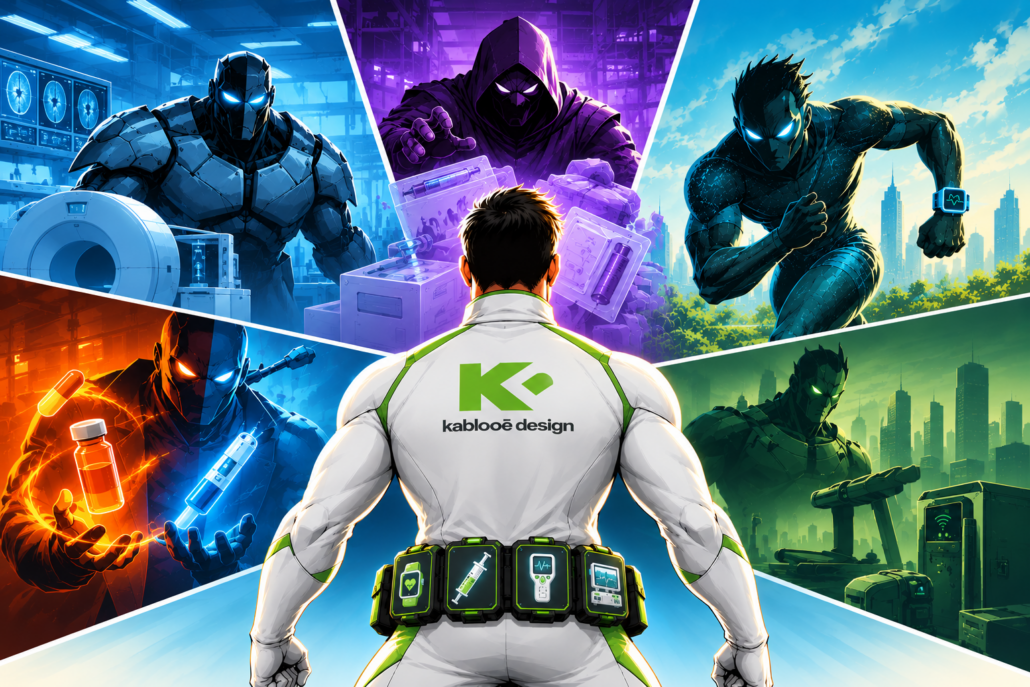
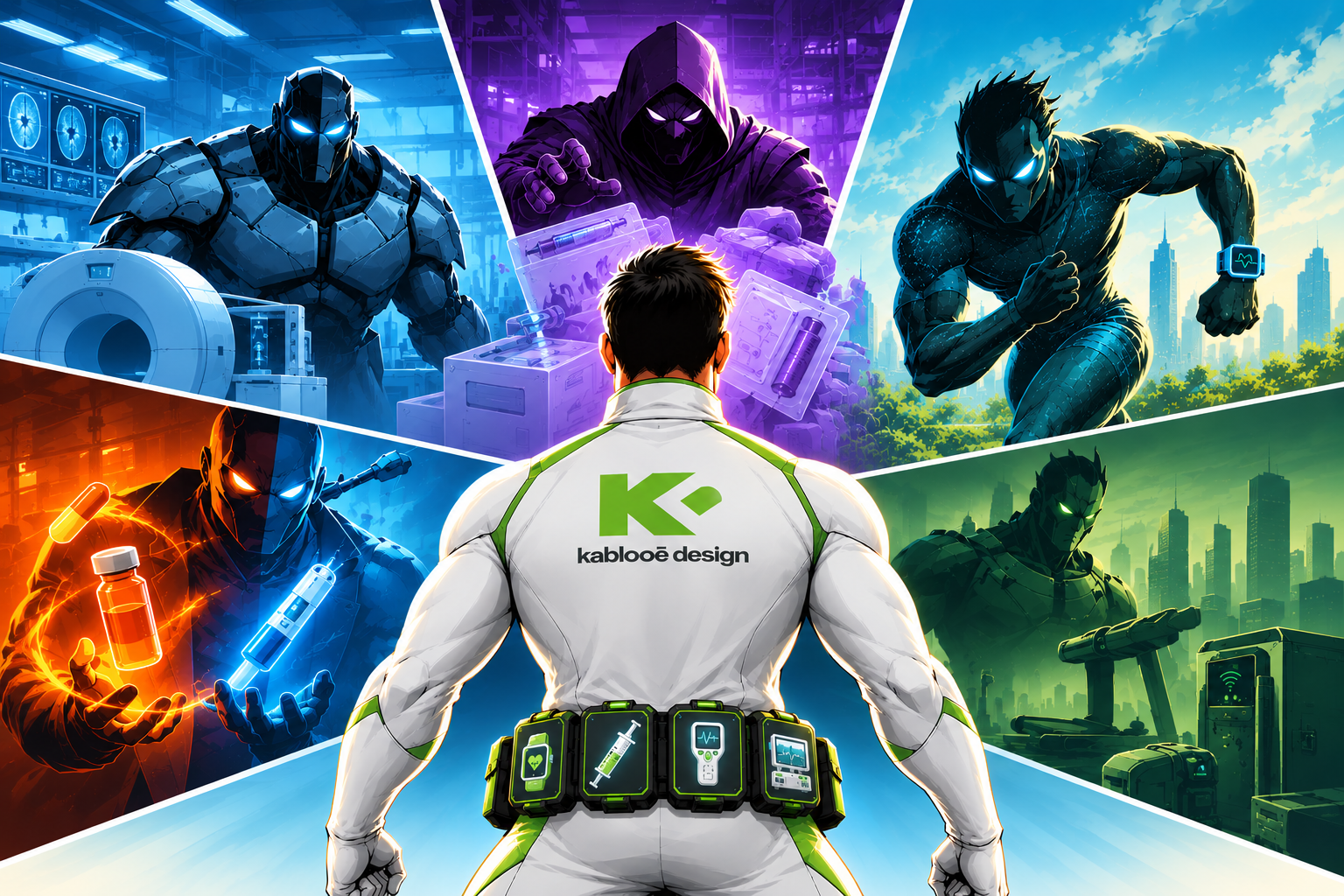
Every hero has an origin story. A first rescue, a first villain, a first sign that they were built for something more than an ordinary day job.
The real test of a hero isn’t their first victory; it’s whether they can show up for the next challenge, the one after that, and whatever challenges continue to come.
That’s the standard we hold ourselves to at Kablooe. Medical device development isn’t one job. Kablooe’s work is dozens of different jobs working towards the positive outcomes our clients depend on, and every medical device category comes with its own risks, regulations, and reasons to fail if you’re not ready for it.
Taking on All Challenges with The Utility Belt
No hero shows up to every situation with only the same tool. They show up with a utility belt, a full set of capabilities they can reach for depending on what the moment needs.
At Kablooe, that utility belt is our cross-disciplinary team: industrial design, mechanical engineering, electrical engineering, software engineering, biomedical engineering, and human factors research, all working under one roof instead of scattered across outside vendors. When a project calls for a different combination of tools than the last one did, we don’t have to go looking for a new partner. All we have to do is utilize another tool on the belt.
That flexibility is critical because medical devices don’t come in just one shape. They come in different categories of medical devices, and each one has its own version of “the villain.”
Know Your Villains
Every hero worth remembering has a rogues’ gallery, a lineup of distinct villains, each demanding a different strategy to beat. Medical device categories work the same way. Every category of medical devices comes with its own version of the villain, and knowing which one you’re up against changes everything about how you approach the fight.
1. Capital Equipment: The Long Game
Capital equipment, think diagnostic imaging systems, surgical platforms, and other large, high-investment devices, plays a long game. These products need to perform consistently and reliably for years, usually in high-stakes clinical environments with minimal downtime. The challenge here isn’t just building something that works on day one; it’s engineering something that works for the thousandth time and beyond, while enduring a battery of use cycles, tough sterilization protocols, and the wear and tear of a busy hospital floor.
2. Disposables: Small Product, Big Stakes
Disposable components are deceptively simple. Commonly used in diagnostic equipment, these single-use devices might look basic on the surface, but it needs to be manufacturable at scale, cost-effective, and foolproof for anyone who may only interact with it once. There’s no room for a learning curve, and the design has to be right the first time, every time.
3. Wearables: Designed for Real Life
Wearable medical devices have to survive contact with the messiest, least controlled environment there is: everyday life. Sweat, movement, forgetfulness, and inconsistent use all have to be accounted for in the design. A wearable that performs beautifully in a lab and falls apart on a real patient’s wrist hasn’t solved the problem it was built for.
4. Surgical Devices: No Room for Hesitation
Surgical devices operate in the highest-stakes environments there are: mid-procedure, with a patient on the table and a physician who needs the device to perform exactly as expected, every single time. There is no opportunity to pause for troubleshooting and no second chances if something feels off. The challenge here is designing for absolute reliability under the most extreme pressure, while keeping the physician’s hands, instincts, and workflow at the center of every decision.
5. In-home Health Devices
In-home medical devices face a villain most clinical devices never have to fight: total independence. There’s no nurse to double-check the setup, no technician to troubleshoot any problems, and no medical expert to answer any questions. The device has to be simple enough for a patient or caregiver to use correctly on their own, resilient enough to handle a home environment instead of a sterile one, and simple enough to avoid the consequences that come from user error.
6. Combination Products: Two Villains, One Fight
Combination products are devices paired with a drug or biologic and have a unique complication: they’re not just solving one regulatory puzzle; they’re solving two at once. Device performance and drug delivery both have to hold up under scrutiny, and the human factors work has to account for how a patient interacts with both halves at the same time.
Think Beyond the City Limits
A hero worth their reputation doesn’t stay confined to one city or one kind of threat forever. The same instincts and skills that protect one neighborhood often translate well beyond it.
The same has proven true for us. While medical devices are where Kablooe has built its deepest expertise, the underlying discipline of human-centered design, extensive engineering, and design for manufacturability doesn’t stop at the edge of healthcare. We’ve applied that same approach to fitness equipment, access control technology, and other consumer and industrial products where usability and reliability matter as much as they do in the hospital.
No Challenge Too Big for Kablooe
Great product development doesn’t come from mastering one category and hoping the next project looks the same. It comes from building a team with enough range to meet whatever category shows up next, and treating each one with the same rigor.
That’s not just a catchphrase for us. It’s how we’ve operated for 35+ years.
Got a device that doesn’t fit neatly into one category, or a challenge that seems too big to defeat? That’s exactly the kind of call we like getting. Let’s talk.