Fail Early, Fail Often, Fail Smart: The Power of Iterative Design


Failure has a branding problem.
In product development, especially in medical technology, failure can sound like the thing everyone is trying to avoid. Failed tests. Failed launches. Failed assumptions. Failed investments.
But when failure happens early, intentionally, and in the right environment, it becomes one of the most valuable tools in the entire design process.
That is the heart of the “fail fast” philosophy. It doesn’t mean being careless. It doesn’t mean skipping rigor, ignoring risk, or rushing to market with an unfinished idea. It means creating a development process where teams can learn quickly, test assumptions, expose weaknesses, and make better decisions before those problems become expensive.
In other words, fail fast is not really about failure. It’s about learning faster.
At Kablooe, we’d take that idea one step further: fail early, fail often, and fail smart.
The “smart” part matters. It’s not enough to build something quickly and test it. The real opportunity is to use the lowest-fidelity tool that can answer the question in front of you. Sometimes that’s a rough prototype. Sometimes it’s a simple model. And sometimes, the smartest move is still the oldest one in the designer’s toolkit: a sketch.
For companies navigating new product design, medtech innovation, or complex engineering challenges, the benefits of iterative design are hard to overstate. Iteration helps teams move from idea to insight, from assumption to evidence, and from rough concept to stronger product with less wasted time and fewer costly surprises.
Key takeaway: The biggest benefit of iterative design is faster, cheaper learning. Iterative design and prototyping let teams test rough concepts early, expose problems while they’re still easy to fix, and avoid costly late-stage changes. This advantage is especially valuable in medical device development.
What is Iterative Design?
Iterative design is a development approach built around repeated cycles of creating, testing, learning, and refining. Instead of waiting until a product is nearly finished to discover whether it works, teams make ideas visible early and improve them through feedback. That visibility might come from a prototype, but it can also come from a sketch, storyboard, workflow map, foam model, cardboard mockup, or quick digital wireframe.
That distinction is important. Iteration doesn’t always mean jumping straight into CAD, 3D printing, or a polished prototype. In fact, moving too quickly into high-fidelity tools can make teams feel further along than they really are. The concept may look real, but the underlying idea may not be ready.
A typical cycle might look like this:
- Identify a user need or product challenge
- Create a quick sketch, concept, sketch, model, prototype, or workflow
- Test it with users, stakeholders, engineers, or internal teams
- Learn what works and what doesn’t
- Refine the design and repeat
This process is especially powerful because it turns uncertainty into information. Every prototype, test, and design review helps the team understand the product more clearly.
A major benefit of iterative design is that it allows teams to discover problems while they’re still relatively easy to fix.
A confusing interface is easier to correct in a wireframe than in finished software. A poor ergonomic decision is easier to address in a foam model than after tooling. A workflow issue is easier to solve during early usability testing than after a regulatory submission or market launch.
Iteration gives teams room to learn before the stakes get too high.
Why “Fail Fast” Works (i.e., The Benefit of Iterative Design)
The “fail fast” mindset works because it changes when teams expect to learn.
In a traditional development process, teams may spend significant time refining a concept before putting it in front of users. That can feel efficient, but it often creates false confidence. The product may look polished, but if the core assumptions are wrong, the team has simply spent more time developing the wrong answer.
Iterative design flips that model. It encourages teams to test the rough version before they fall in love with it.
That might mean mocking up a device interface before software development begins. It might mean building a low-fidelity physical prototype to evaluate hand placement, reach, visibility, or workflow. It might mean putting a concept in front of nurses, clinicians, caregivers, or patients to understand whether the design supports how people actually behave.
This is where the power of design becomes practical. Design isn’t just about making a product look refined. It’s about making ideas tangible enough to evaluate, challenge, and improve.
The earlier a team can see the idea, touch it, use it, question it, and break it, the faster they can make it better.
Fail Smart Starts Before the Prototype
It’s tempting to skip sketching.
Modern tools make it easier than ever to jump straight into CAD, generate slick visuals, 3D print a form, or build a functional prototype. Those tools are incredibly valuable, but they can also pull teams forward too quickly. When an idea looks refined, people tend to treat it as more resolved than it actually is.
Sketching slows that impulse down in the best possible way.
A sketch is fast, inexpensive, and flexible. It invites conversation instead of commitment. It lets teams put multiple ideas next to each other, compare directions, combine features, challenge assumptions, and invite feedback before time and money are spent making the concept feel “real.”
That’s where “fail smart” becomes different from simply failing fast. The point isn’t to prototype everything as quickly as possible. The point is to learn as quickly and efficiently as possible.
Early sketches can help teams ask better questions, such as:
- Which concept best supports the user’s workflow?
- Which form feels most intuitive before we invest in modeling it?
- Where might users misunderstand the interface, grip, sequence, or setup?
- Which ideas should move forward, merge, or disappear?
- What do stakeholders react to before the design becomes expensive to change?
This is especially valuable in medical product development, where decisions about form, workflow, interaction, labeling, and use environment can affect usability, risk, documentation, and development cost.
At Kablooe, sketching isn’t treated as a nostalgic design exercise. It’s a strategic tool. It helps teams explore more options earlier, involve stakeholders sooner, and bring users into the conversation before the product has already started hardening around one direction.
Iterative Design and Prototyping Reduce Costly Mistakes
One of the biggest advantages of iterative design and prototyping is that it helps teams avoid expensive late-stage changes.
Late changes are costly for several reasons. They may require:
- Redesigning parts
- Rewriting software
- Repeating tests
- Updating documentation
- Changing suppliers
- Revising tooling
- Reopening decisions that the team thought were already complete
In regulated industries like medical device development, those changes can create even more complexity. A seemingly small design update may affect risk documentation, usability validation, verification planning, labeling, manufacturing assumptions, or regulatory strategy.
That’s why early iteration matters so much.
Prototypes don’t need to be perfect to be useful. In fact, early prototypes should often be intentionally rough. A quick sketch, crude model, clickable mockup, or basic functional prototype can reveal critical information long before the product is ready for formal testing.
The trick is choosing the right level of fidelity for the decision you need to make. If the team is still comparing broad product directions, sketching may be more valuable than CAD. If the question is about hand fit or reach, a foam model may be enough. If the issue is workflow, a storyboard or simulated interface may reveal more than a beautiful render. If the question is technical feasibility, then a functional prototype may be the right tool.
Failing smart means matching the tool to the question.
The goal is not to make something impressive. The goal is to make something learnable.
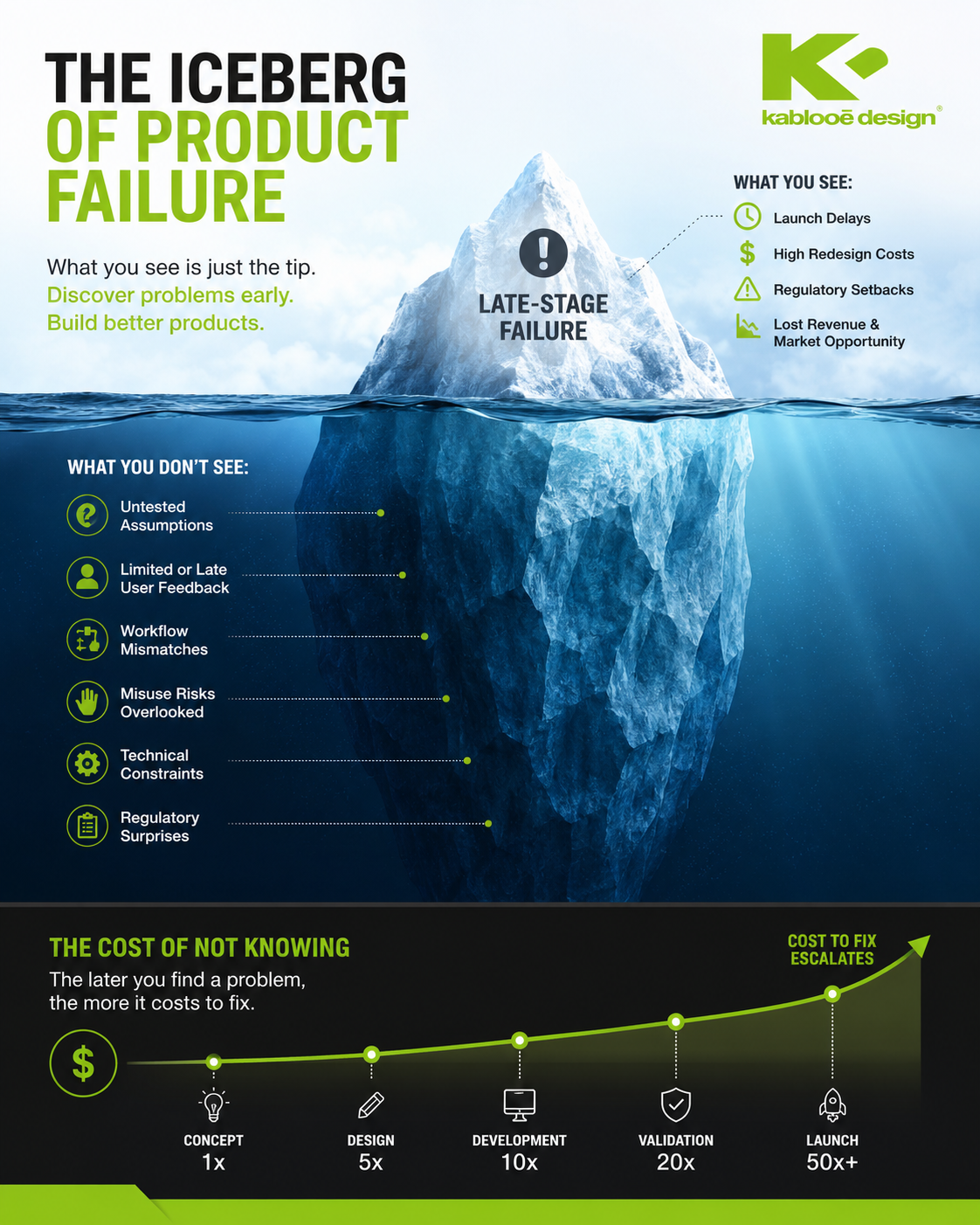
At Kablooe, this mindset is central to Design Driven Development®. By integrating design thinking early, teams can identify usability concerns, technical constraints, and product opportunities before they become more difficult to address.
Iteration Builds Better Medical Products
In medical product development, iteration isn’t just a creativity tool. It’s a risk reduction tool.
Medical devices often operate in high-pressure, high-consequence environments. Users may be distracted, tired, rushed, anxious, or managing multiple tasks at once. A product that looks straightforward in a conference room may behave very differently in a hospital, clinic, lab, home, ambulance, or surgical suite.
That’s why iterative design is so closely connected to human factors and usability.
Early testing helps teams understand questions like:
- Can users complete the task without confusion?
- Are critical controls easy to identify?
- Does the device fit naturally into the workflow?
- Are there opportunities for misuse?
- Could the design increase cognitive load?
- Does the product support safe, confident use?
Kablooe has written before about why teams need to design with misuse in mind. Iteration supports that work by helping teams uncover potential use errors early, when design changes can still be made efficiently.
For companies developing medical products, this can have a direct impact on design quality, usability, safety, and development momentum.
The Cultural Side Of Failing Fast
The technical side of iteration is important. But the cultural side matters just as much.
A team can have access to prototyping tools, testing methods, and design talent, but still struggle if people are afraid to expose unfinished ideas.
To make iterative design work, teams need a culture that treats early failure as useful information, not personal criticism. That means creating space for open feedback, honest testing, and quick learning.
A strong iterative culture encourages teams to:
- Share rough ideas before they feel fully polished
- Ask better questions instead of defending assumptions
- Test with real users whenever possible
- Separate the quality of the idea from the ego of the person who proposed it
- Document what was learned and why decisions changed
- Keep momentum without skipping critical thinking
This is especially important in cross-functional product development. Designers, engineers, clinicians, researchers, executives, marketers, and regulatory teams may all see the product through different lenses. Iteration gives those perspectives something concrete to react to.
When a team is looking at the same prototype, the conversation gets better.
Instead of debating abstractions, the team can evaluate reality.
Faster Does Not Mean Reckless
One common misunderstanding about “fail fast” is that speed comes at the expense of quality.
Done poorly, that can happen. Teams can rush, skip important questions, or mistake constant activity for real progress.
But done well, iterative design actually improves quality. It gives teams more opportunities to identify problems, validate decisions, and refine the product before major investments are made.
The key is disciplined iteration.
Each prototype should have a purpose. Each test should answer a question. Each round of feedback should move the team closer to a better product.
This is why process matters. Without structure, iteration can become circular.
Teams may keep exploring without making meaningful progress. With the right development framework, however, iteration becomes focused, efficient, and productive.
That’s part of the thinking behind Kablooe’s approach to world-class design. Strong design is not random inspiration. It’s a disciplined way of discovering better answers.
How To Use Iterative Design More Effectively
Teams that want to get more value from iteration should start by making it intentional.
- First, identify the riskiest assumptions. What does the product absolutely need to get right?
- Is it the workflow?
- The interface?
- The ergonomics?
- The technical architecture?
- The business model?
- The manufacturing approach?
- Next, visualize those assumptions at the lowest useful fidelity. Don’t wait to build the whole product, and don’t automatically jump to a polished prototype. Build only as much as you need to learn.
- Then, test with the right people. Internal feedback is useful, but real users often reveal issues that internal teams miss. When possible, observe behavior rather than relying only on opinions. What users do is often more revealing than what they say.
- Finally, capture the learning. Iteration is most valuable when insights are documented and connected to decisions. Teams should be able to explain not only what changed, but why it changed.
That is how iteration becomes more than a creative exercise. It becomes a strategic advantage.
For teams that feel stuck in delayed ideation, overbuilt processes, or slow decision-making, our article on how product development processes can delay ideation explores why timing and flexibility matter so much in early development.
Fail Fast, Then Build Smarter
The best product teams don’t fail fast because they expect to fail forever. They fail fast because they expect to learn.
They know that early friction is often a gift. A confusing prototype, an awkward workflow, a failed assumption, or an unexpected user reaction can save months of wasted effort. It can point the team toward a smarter solution. It can reveal a better path.
That’s one of the clearest benefits of iterative design: It helps teams move with confidence because they’re not relying on hope alone. They’re building knowledge into the process.
In medical device development and other complex product environments, that knowledge can make the difference between a product that simply functions and one that truly works for the people who need it.
The power of design is not just in making things beautiful. It’s in helping teams think clearly, learn quickly, and create products that are safer, smarter, and more useful in the real world.
Want a Better Way to Bring Structure, Creativity, and Momentum to Your Next Product Development Effort?
Kablooe’s Design Driven Development® process is built around the belief that great products come from thoughtful design, real user insight, and disciplined development. Whether you’re exploring an early concept, refining a medical device, or trying to reduce risk before launch, the right process can help you fail earlier, learn smarter, and succeed sooner.
Download the D3® Process eBook today to learn how Design Driven Development® can help your team move from idea to impact.
Frequently Asked Questions About Iterative Design
What is a benefit of iterative design?
The clearest benefit of iterative design is that it lets teams discover problems while they are still cheap and easy to fix. By testing rough concepts early, teams catch usability, ergonomic, and workflow issues in a sketch or model instead of after tooling, software development, or regulatory submission.
How is iterative design different from traditional (waterfall) design?
Traditional design refines a concept extensively before testing it with users, which can build false confidence in the wrong solution. Iterative design tests the rough version first, so teams validate core assumptions before committing significant time and budget.
Why does iterative design reduce costs in medical device development?
Late changes in regulated development can ripple into risk documentation, usability validation, verification planning, labeling, and tooling. Iterative design and prototyping surface those issues early, when changes are far less expensive and disruptive.
What is the difference between iterative design and prototyping?
Iterative design is the repeated cycle of creating, testing, learning, and refining. Prototyping is one tool within that cycle. It is the act of making an idea tangible enough to evaluate. The two work together: prototypes generate the feedback each iteration needs.