Is Your MedTech Design Revolutionary or Evolutionary?
In medtech, innovation is often celebrated as if it only comes in one form: the breakthrough. Teams talk about disrupting markets, redefining categories, and launching products no one has ever seen before. That vision can be exciting. It can also be expensive, risky, and—in some cases—unnecessary.
In reality, not every successful product has to be revolutionary. Many of the strongest outcomes in new product design and development come from thoughtful, disciplined evolution. A product does not need to reinvent the entire category to create meaningful value for users, clinicians, or healthcare systems. Sometimes the smartest move is not to start over, but to improve what already works.
That is where the conversation around revolutionary vs evolutionary design becomes especially important. For companies working in the product development of medical technology, the difference is not just philosophical. It affects risk, timelines, usability, regulatory strategy, and the overall path to commercial success.
The Difference Between Revolutionary and Evolutionary Design
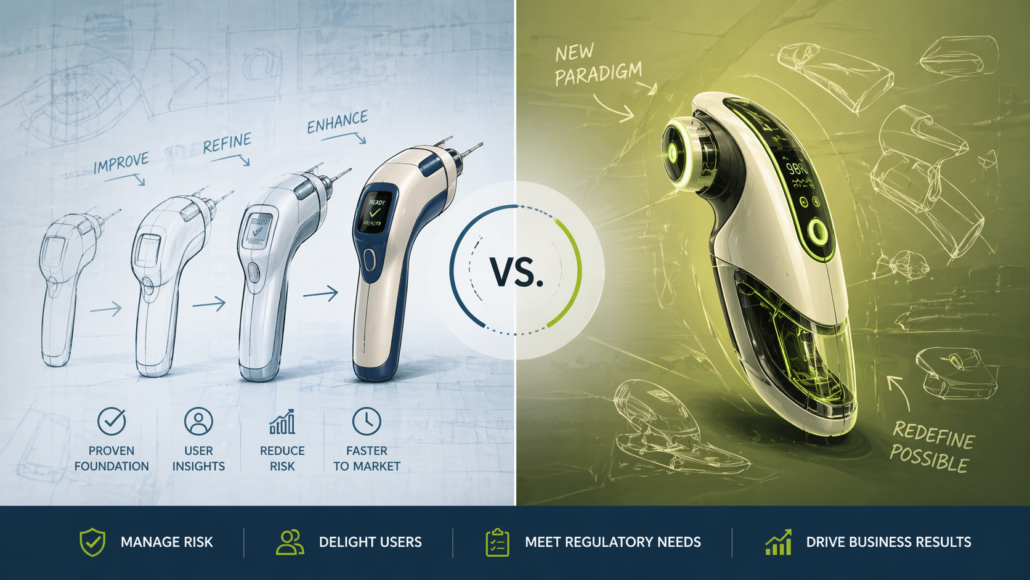
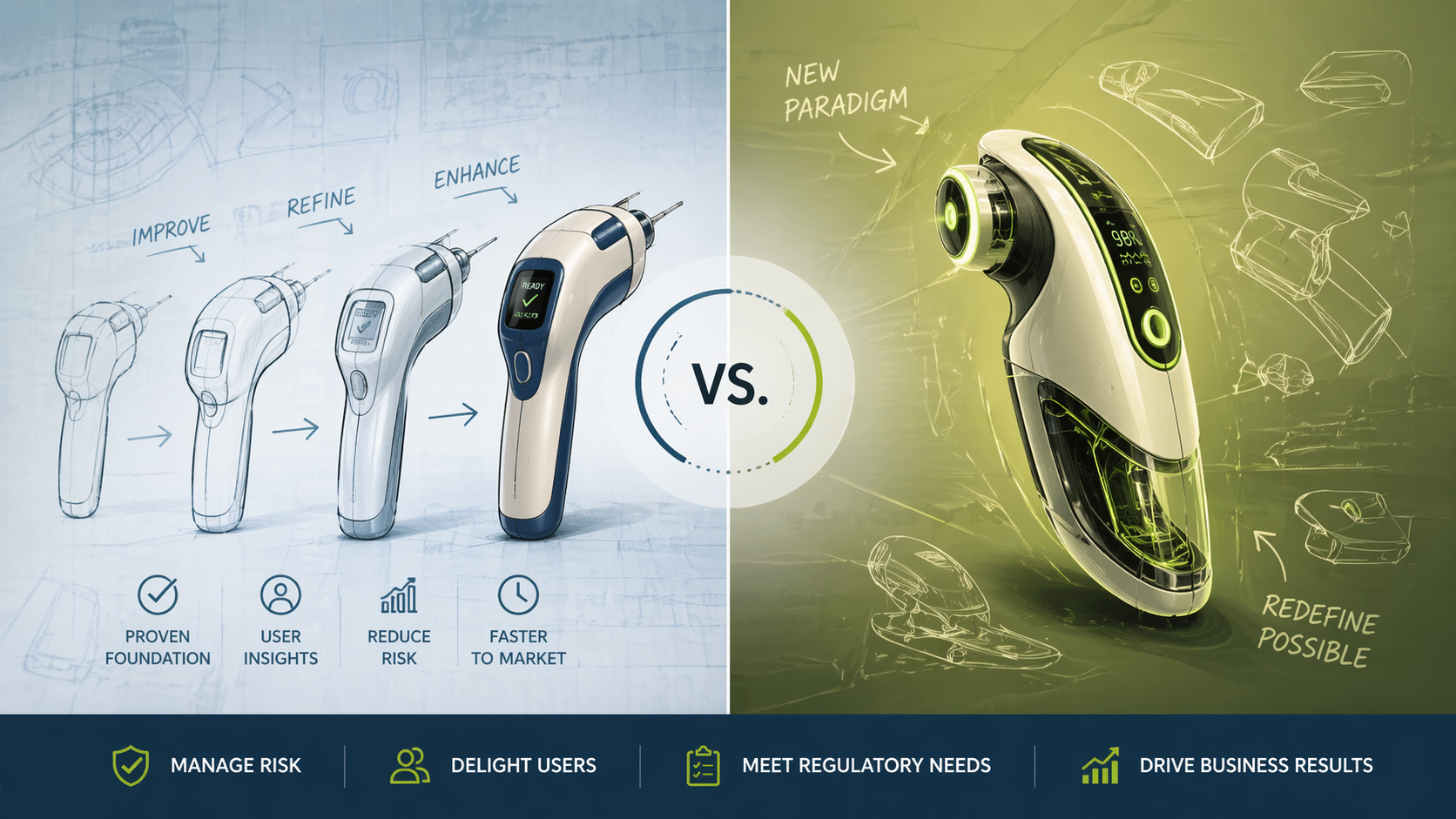
A revolutionary design introduces a fundamentally new way of solving a problem. It often creates a new workflow, a new user experience, or even a new product category. Revolutionary thinking can lead to significant competitive advantage, but it usually asks a lot from the organization behind it and from the people expected to adopt it.
An evolutionary design, by contrast, builds on known solutions. It improves performance, usability, workflow, safety, or manufacturability without forcing users into a completely unfamiliar experience. Evolutionary design does not mean minor or unimportant change. In many cases, it is exactly the right level of innovation for the market.
For companies focused on the design and development of new products, this distinction matters because the best innovation strategy is not always the boldest one. It is the one that best matches user needs, regulatory realities, and business goals.
Why Evolutionary Design Deserves More Respect
There is a tendency to treat incremental improvement as less impressive than breakthrough innovation. In medtech, that is often the wrong mindset.
Medical devices exist in highly constrained environments. They are used by clinicians, technicians, patients, and caregivers who need reliability, clarity, and confidence. A dramatic leap forward may sound compelling in a pitch deck, but in practice, products succeed when they fit real-world behavior and reduce friction.
Evolutionary design allows teams to build on existing patterns that users already understand. That can improve adoption, reduce training burden, and create a more intuitive experience. It can also help development teams stay focused on the areas where change will matter most.
This is especially true in new product design and development for regulated industries. When the stakes are high, the goal is not innovation for its own sake. The goal is better outcomes.
Where Revolutionary Design Gets Expensive
The biggest difference in the revolutionary vs evolutionary debate is often risk.
Revolutionary products carry greater technical risk because they frequently rely on unproven mechanisms, new architectures, or unfamiliar interfaces. They also carry market risk because users may not immediately understand the value or may resist changing established workflows. Internally, revolutionary projects can create strategic risk by requiring larger budgets, more rounds of iteration, and more difficult decision-making when early assumptions do not hold up.
Evolutionary design typically lowers those risks. By building from predicate products, known workflows, or validated user expectations, teams can reduce uncertainty and make smarter tradeoffs earlier in development. That does not eliminate risk, but it often makes risk easier to identify and manage.
For leaders responsible for the product development of medical technology, this matters a lot. A product that improves usability, reduces user error, and fits into existing clinical practice may create more practical value than a concept that looks impressive but struggles to gain traction.
Regulatory Burden Changes the Equation
In medtech, design strategy is inseparable from regulatory strategy.
A revolutionary concept may require more extensive testing, more robust clinical evidence, or a more complex submission pathway. Depending on the product and its claims, the regulatory burden can rise quickly. More novelty often means more questions from regulators, more documentation, and more time spent validating that the product is safe and effective.
Evolutionary design can sometimes make that path more manageable. When teams build on known device types, familiar user interactions, and established risk controls, they may be better positioned to support a smoother regulatory process.
That is one reason the design and development of new products in medtech requires more than creativity. It requires disciplined thinking about how product decisions will affect verification, validation, usability testing, risk management, and submission strategy.
This is also why Kablooe believes great design should be grounded in both empathy and process. A strong concept is only part of the answer. It also has to survive the realities of development, documentation, and regulatory scrutiny.
Innovation Does Not Have to Mean Disruption
One of the most common mistakes in new product design and development is equating innovation with novelty alone. But innovation can also mean removing friction, clarifying a workflow, reducing cognitive load, improving ergonomics, or helping users complete a task more safely.
That kind of progress is often evolutionary, and it can be incredibly valuable.
A device that feels more intuitive in the hand, reduces the chance of user error, or better supports a clinician’s workflow may not look revolutionary from the outside. Yet those improvements can directly affect adoption, satisfaction, and outcomes. In the product development of medical technology, those results matter more than whether the product appears dramatic in a launch announcement.
The most effective teams understand this.
They do not ask, “How do we make this seem groundbreaking?”
Instead, they ask, “What kind of innovation best serves the user, the business, and the regulatory path?”
When Revolutionary Design Makes Sense
None of this means revolutionary design is the wrong choice. Sometimes the problem is so significant, or the unmet need so clear, that incremental improvement is not enough.
If existing solutions fundamentally fail users, a revolutionary approach may be necessary. If the market is ready for a new paradigm and the organization has the resources to support deeper validation, broader testing, and a longer road to launch, then bold innovation may be worth pursuing.
But even then, revolutionary thinking benefits from a disciplined development process. The more ambitious the vision, the more important it is to anchor decisions in user insight, prototyping, risk analysis, and cross-functional collaboration.
That is part of what Kablooe calls Design Driven Development®: integrating design thinking early so products are shaped by real user needs, technical realities, and business constraints from the beginning.
Choosing the Right Path for Your Product
So, how do you decide between revolutionary and evolutionary?
Start with the user:
- What problem are they really trying to solve?
- What frustrations exist with current solutions?
- Which behaviours are deeply ingrained, and which could realistically change?
Then consider the development pathway:
- How much technical uncertainty exists?
- How much regulatory complexity can the programme absorb?
- What level of documentation, testing, and validation will be required to support the design?
Finally, look at the business case:
- Are you trying to create a new category?
- Or do you want to win by being easier to use, easier to adopt, and easier to integrate into current workflows?
For many medical device teams, the best answer lies somewhere between the extremes.
A product may be evolutionary in its regulatory posture but still feel meaningfully innovative to the people using it. That is often where the most successful new product design and development happens.
At Kablooe, we help teams navigate these tradeoffs through world-class design, a practical understanding of regulated development, and deep experience in medical product design services. The goal is not to force every program into the same innovation model. The goal is to identify the right strategy for the product, the user, and the market.
Need Help Balancing Innovation and Risk?
The choice between revolutionary and evolutionary design is not always simple. Kablooe helps product teams evaluate tradeoffs, reduce development risk, and build smart paths forward for medical device innovation.
Contact us today to talk through your goals and challenges.