From Napkin Sketch to Market-Ready: A Sketch-to-Production Design Story
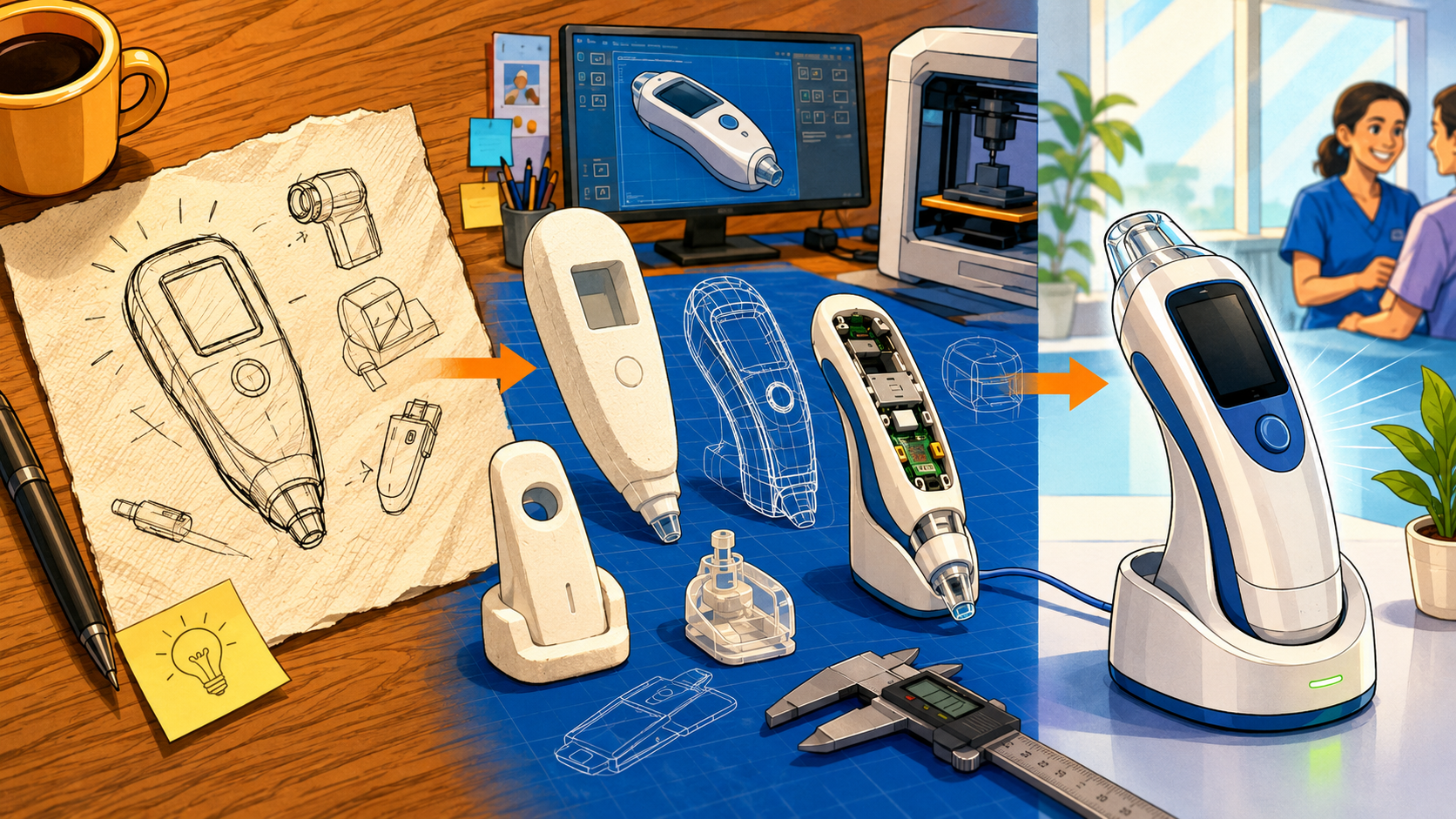
What do superheroes and great products have in common? They have origin stories.
Sometimes it starts as a clinical frustration.
Sometimes it begins with a founder’s “what if?”
Sometimes it’s a rough sketch on a whiteboard, a napkin, or the back of a meeting agenda while someone tries to explain the thing that doesn’t exist yet.
But the sketch… the sketch is only the beginning.
This article follows that evolution visually, using six real Kablooe case studies to show how early concepts become refined, functional products. But before we do, let’s take a look at what product innovation really means and why the journey from idea to execution is often where the most important design work happens.
What is Product Innovation?
At its simplest, product innovation is the process of turning a new idea, improved feature, or better user experience into a product that creates real value. That might mean building something entirely new. It might mean rethinking how users interact with an existing category. Or it might mean making a device simpler, safer, more intuitive, more manufacturable, and more ready for the market it needs to serve.
Why the Sketch is the Easy Part
Because ideas don’t succeed on intention alone.
A product can be technically impressive and still fail if users don’t understand it. It can be beautiful and still fail if it can’t be manufactured. It can be innovative and still fail if it doesn’t solve a meaningful problem in a way people can trust.
That’s especially true in medical device design and other complex product categories, where the stakes are higher and the margin for confusion is smaller. Strong product innovation connects the original idea to the realities of users, environments, safety, cost, production, and long-term adoption.
If what you want is the argument for why a disciplined innovation process beats a good idea, we’ve made that case separately.
That’s why the visual journey matters. When you compare an early sketch to a finished product, you see more than an aesthetic evolution. You can see:
- Decisions
- Tradeoffs
- Testing
- Risk reduction
- Engineering discipline
- Human behavior
- The messy middle where the product becomes real
To see that in action, it helps to look at the transformation itself: the early sketches, rough prototypes, refined forms, and finished products that show how an idea becomes something people can actually use.
The following examples highlight how Kablooe moves product innovation from abstract possibility to practical, market-ready design.
1. From Patient Transfer Problem to Production-Ready Solution
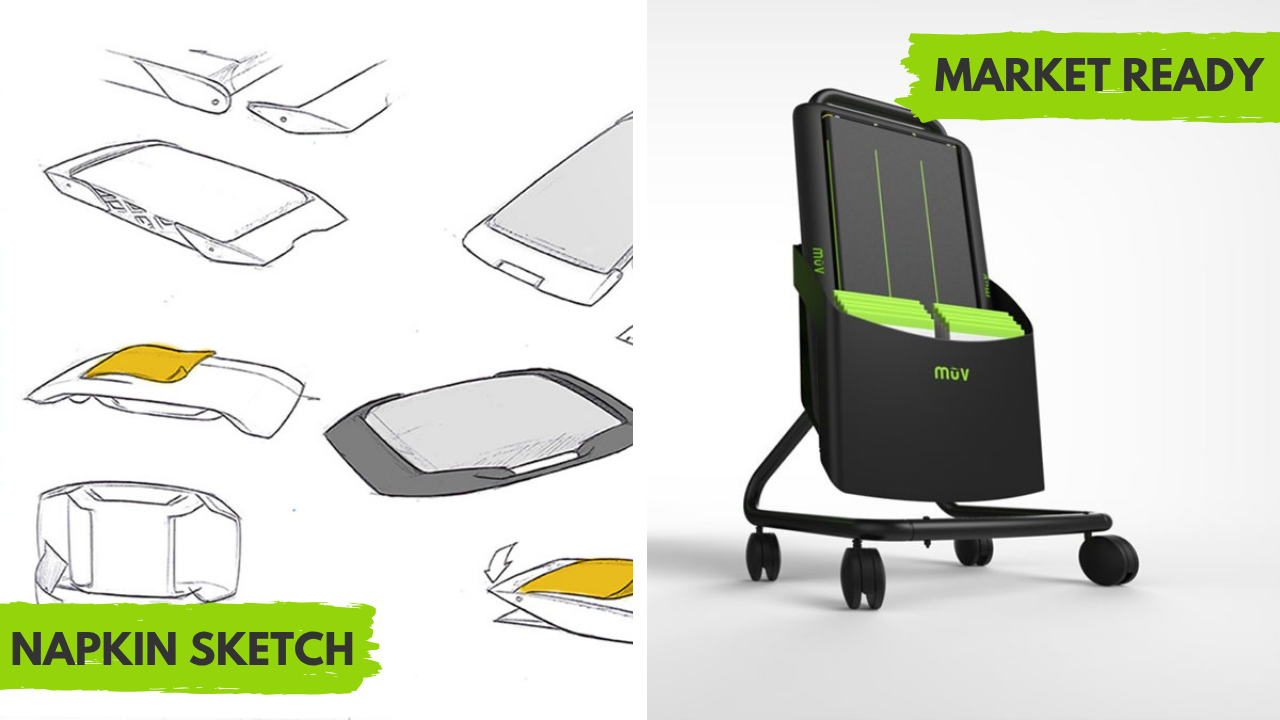
This is a strong example of new product innovation because the challenge wasn’t simply to “design a device.” The challenge was to rethink an everyday clinical workflow that affects patients and caregivers at scale.
CEGA Innovations set out to create a better patient transfer experience, addressing a process that can create discomfort, re-injury, cross-contamination risk, and physical strain on medical personnel. Kablooe used its D3 Process® to understand the difficulties hospital staff experience during patient transfers, then developed a smaller, lighter prototype that could be easily sterilized and eventually refined into a production-ready solution.
The finished product looks inevitable when you see it fully resolved. But the path from sketch to solution required deep observation, user empathy, prototyping, and careful refinement. That’s where product innovation becomes more than invention. It becomes problem-solving with consequences.
The result: The MuV patient transfer system went on to win recognition in the Medical Design Excellence Awards, and was engineered to stay under 15 pounds so a single staff member could carry it, while still supporting patients up to 300 pounds.
2. From Complicated Injection to a Simpler Auto Injector Platform
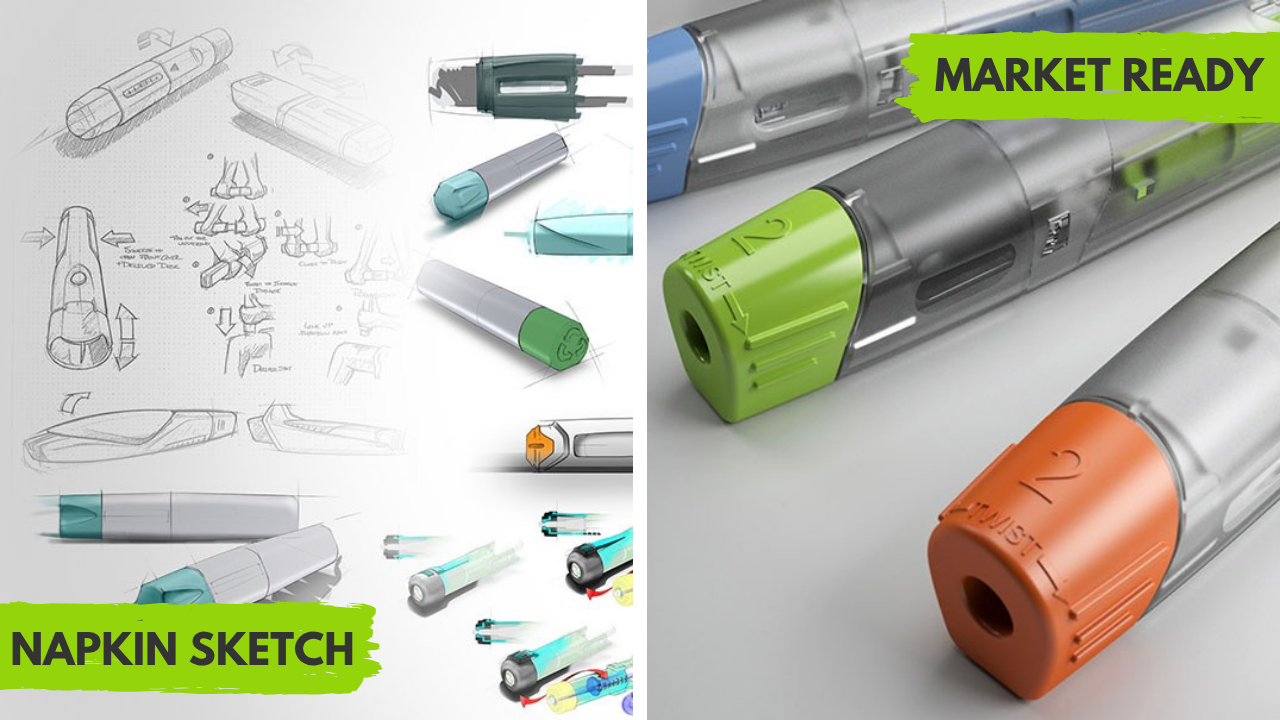
Sometimes, the biggest innovation is simplification.
Antares Pharma (now Halozyme) wanted to gain a competitive advantage in the generic drug auto injector marketplace. Kablooe helped develop a simplified self-injection product platform designed to support multiple drugs, improve patient safety, and create better outcomes. The team simplified device operation from seven or more steps down to three while adding features such as a needle lockout and drug viewing window.
That before-and-after story is powerful because it shows how design can reduce cognitive load. A self-injection device may involve mechanics, materials, drug compatibility, and manufacturing constraints, but to the person using it, the product has to answer one question quickly: Can I do this correctly and confidently?
3. From Veterinary Workflow Challenge to an Automated Digital Microscope
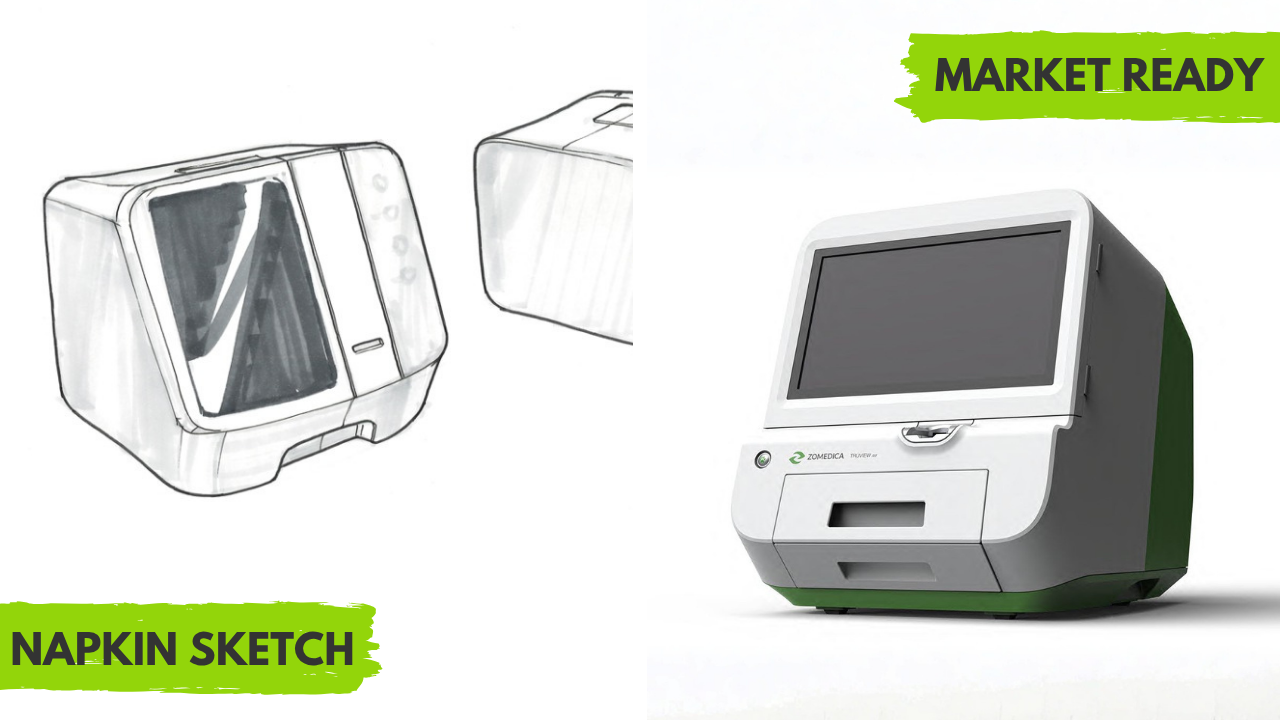
This is a great example of how product innovation can happen at the intersection of automation, workflow, and user confidence.
Zomedica wanted to create a fully automated digital microscope that could prepare and digitize hematology and cytology slides for pathologist review in minutes. Kablooe improved the use flow and ergonomics of the TruView device, creating a rugged, easy-to-use enclosure and interface that protects the slides and calibrated mechanisms inside.
The technology matters, of course. But the experience around the technology matters too. Where does the slide go? How does the user know the process is working? What needs to be protected? What needs to be accessible? What should feel simple, even if the internal system is complex?
This is the difference between making a machine and designing a great product.
4. From Emergency Conditions to a Rugged Handheld Monitoring System
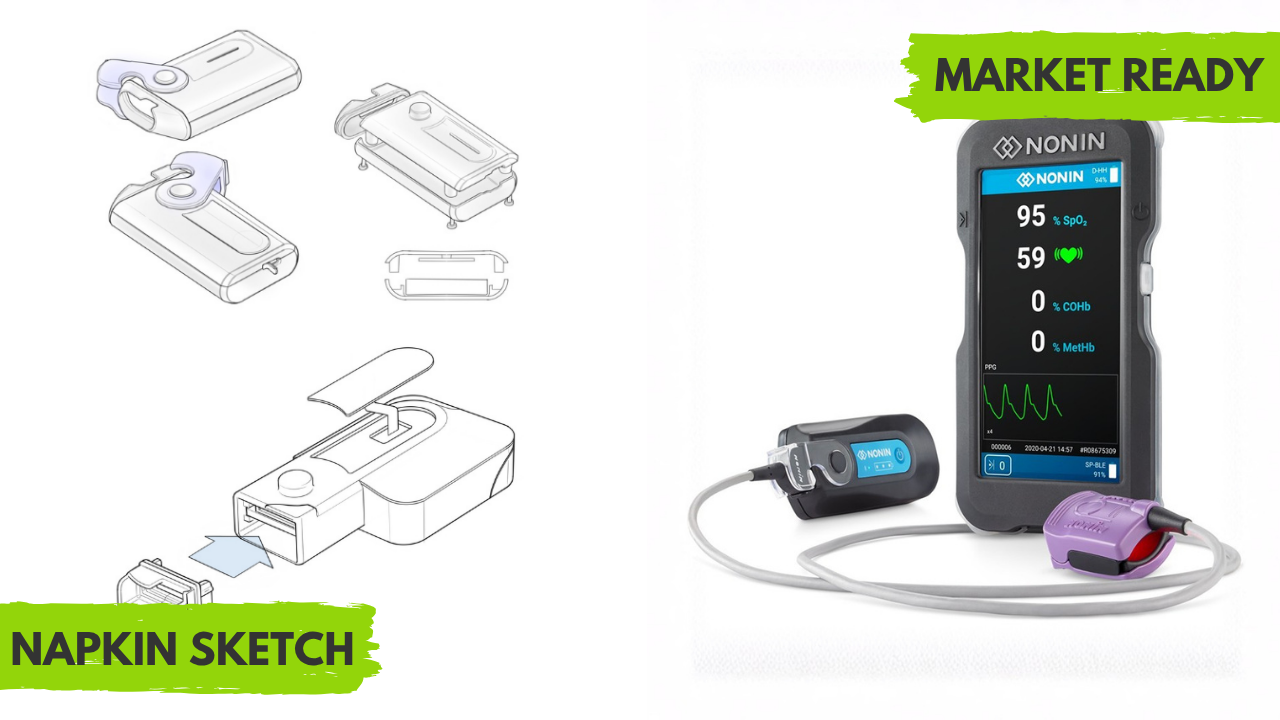
Emergency responders don’t use devices in calm, perfect conditions. They use them in the field, under pressure, with real patients depending on fast, reliable decisions.
Nonin Medical partnered with Kablooe to develop a patient monitoring solution that would be easy to use, rugged, reliable, and capable of producing consistent measurements for emergency responders. Through the D3 Process®, Kablooe created a rugged hand interface that protected the device and connection points while keeping the design lightweight, handheld, easy to carry, and simple to use.
The finished CO-Pilot™ Wireless Handheld Multi-Parameter System shows how product innovation often comes down to designing for the environment, not just the product category. In this case, durability, portability, usability, and trust all had to work together.
5. From Diagnostic Vision to a More Usable Autism Evaluation Device
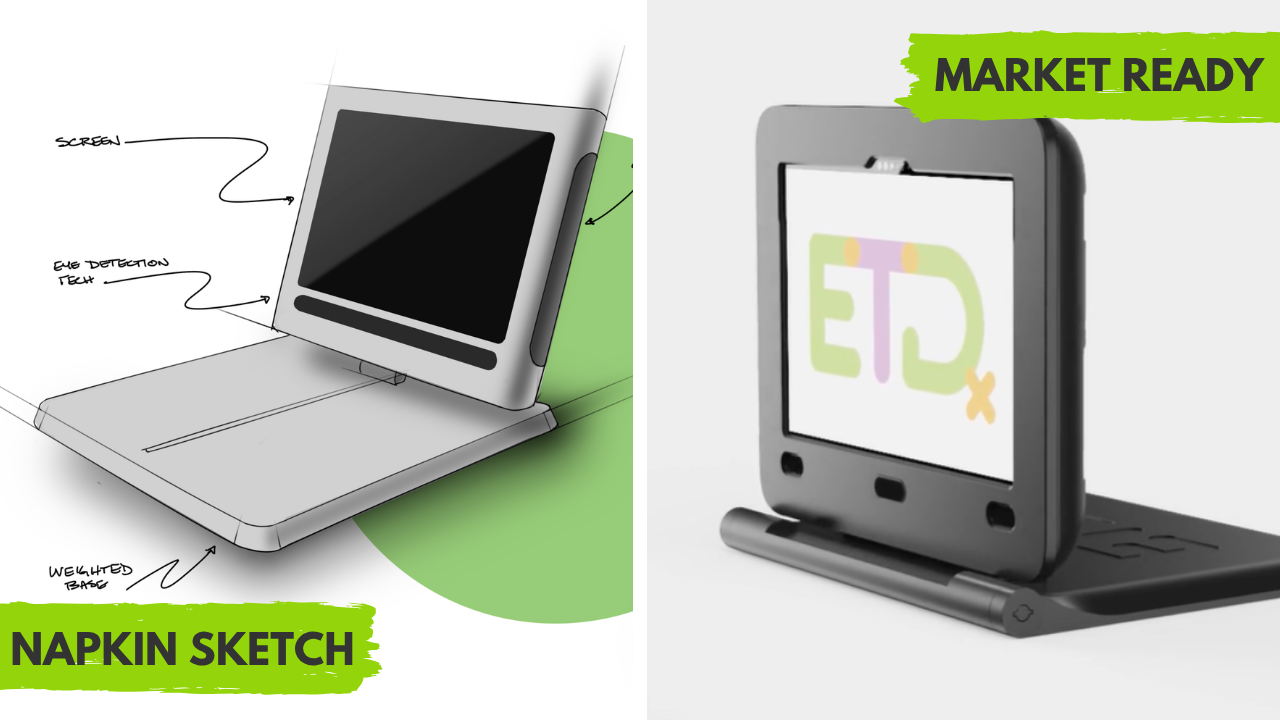
Product innovation can also mean helping an important technology fit the real world.
EarliTec Diagnostics (now EarliPoint Health) needed a product design partner to help bring the EarliPoint™ Evaluation device to life for earlier autism diagnosis. The device needed to accommodate a wide range of seated user heights while minimizing tipping risk, and Kablooe supported nearly every stage of product development, from research to testing. The final solution included a stand and case with a knob interface for quick, secure height adjustment.
This is the kind of detail that may look simple in the final product, but it’s anything but simple during development. Height adjustment. Stability. Child users. Clinical workflow. Accuracy. Safety. Cost targets. Each requirement shapes the design. The best solutions often feel obvious only after the team has worked through all the complexity.
6. When Improving an Existing Device is the Smarter Move
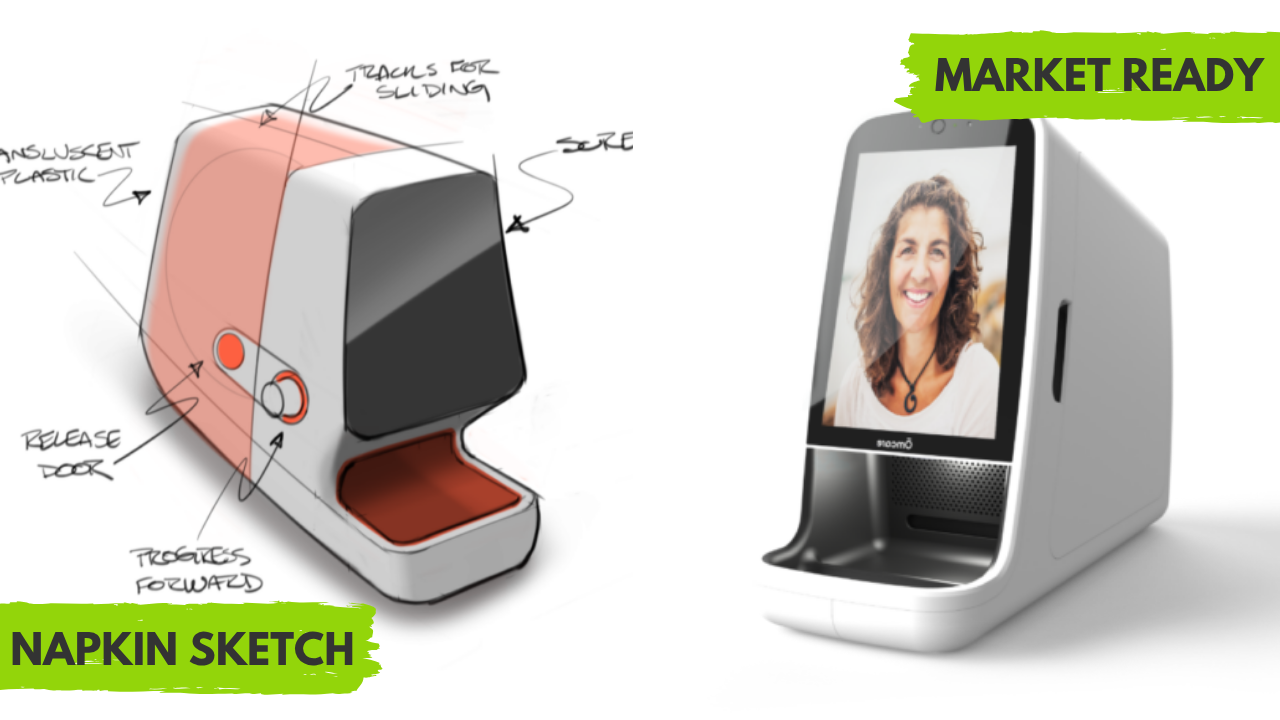
Not every product innovation starts with a blank page.
Sometimes, a modification to an existing product innovation can create enormous value. A better interface. A safer enclosure. A clearer workflow. A smaller footprint. A more intuitive interaction. A more manufacturable design.
Ōmcare is a strong example. The vision was an in-home healthcare device that connected robotic medication dispensing with video confirmation, helping caregivers know whether a dose was missed or incorrectly administered. Kablooe enhanced the device’s functionality and usability through locked medication storage, multi-dose dispensing, and a simple one-touch interaction.
Remember: The Sketch is Just the First Frame
A napkin sketch is exciting because it captures possibility.
But market-ready products require more than possibility. They require a process that can pressure-test the idea from every angle: user need, technical feasibility, risk, usability, manufacturing, business strategy, and product-market fit.
That’s why Kablooe’s process puts so much emphasis on the messy middle. Early product development ideation helps teams explore more than one path before they overcommit. A disciplined development roadmap helps teams move from inspiration to execution with fewer surprises. And the right partner can help connect those decisions across the full journey, from first sketch to product launch.
What Actually Happens Between the Sketch and the Shelf
Those are just six sketch-to-production design stories. There are plenty more in the full Kablooe case study library, spanning medical, consumer, and industrial products!
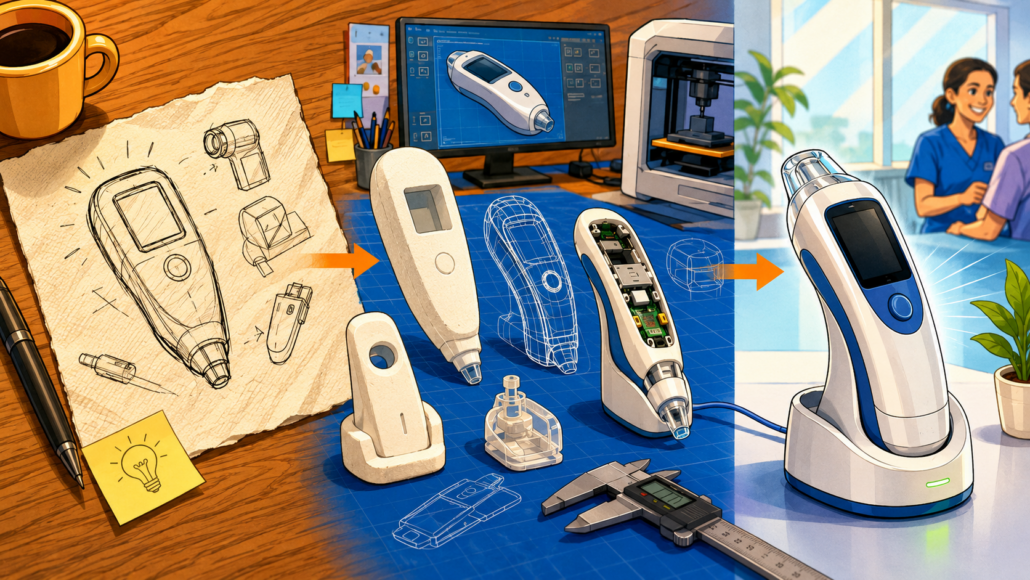
It’s important to note that every example we shared skipped the part that takes the longest. Here’s what actually fills the gap between the left panel and the right panel, using the seven phases of Kablooe’s Design Driven Development® process:
- Evaluation. Is the idea worth building? What already exists, what does it cost, and what would have to be true for it to succeed?
- Research. Who actually uses this, and in what conditions? For CEGA, that meant watching nurses move real patients, not reading about it.
- Ideation. Many directions explored cheaply, before anyone commits to one. This is the phase most teams cut, and the one that most often decides the outcome.
- Design. Form, interface, and use flow resolved together. Usability engineering under IEC 62366-1 lives here, which is why human factors work belongs early rather than at validation.
- Engineering. Mechanisms, materials, electronics, and tolerances. Risk management under ISO 14971 runs alongside, so hazards are designed out rather than documented after the fact.
- Testing. Prototypes built to be broken, then revised. Feasibility modeling answers the questions a rendering cannot, then alpha and beta prototypes are used to verify and validate the design.
- Technology transfer. Handing a design to manufacturing without losing what made it work. Kablooe is ISO 13485 certified, so the documentation trail holds up to an audit.
Ready to Take Your Idea Off the Napkin?
Whether you’re starting with a rough concept, rethinking an existing device, or preparing for the next stage of development, Kablooe can help you turn early ideas into products that are usable, manufacturable, and ready for the market.
Want a closer look at how our process works? Download the D3 Process eBook to see how Design Driven Development® helps teams move from insight to innovation with greater clarity and confidence.
Have a product idea you’re ready to explore? Contact us today to start the conversation.
Frequently Asked Questions
How long does it take to go from concept to a market-ready medical device?
It depends far more on regulatory class and testing burden than on design time. A Class I accessory can move in months. A Class II device requiring human factors validation and a 510(k) submission typically runs one to three years from first sketch to launch. The design work is rarely the bottleneck. Verification, validation, and manufacturing transfer usually are.
What is the difference between a prototype and a production-ready design?
A prototype proves an idea can work. A production-ready design proves it can be made repeatably, safely, and at a cost that supports the business, with the documentation to back it up. Most projects that stall have a working prototype and no path to a production-ready design.
When should a startup bring in a product design partner?
Earlier than most do. Once you are confident there is a real user problem but before you have committed to a specific mechanism or form. Bringing a partner in after the design is locked usually means paying twice, because the fixes land in engineering where changes are most expensive.
Do you need a finished design before you can start regulatory work?
No, and waiting is a common mistake. Risk management under ISO 14971 and usability engineering under IEC 62366-1 are meant to run alongside design, not after it. Starting them late is how teams end up redesigning a device to satisfy a hazard analysis they could have run in month two.